Core concepts
Layers
Introduction
Cycloid relies on a layered organizational model to structure infrastructure, applications, and deployments.
At a high level, Cycloid is structured as follows:
Organization
 └── Project
      └── Environment
          └── Component
Layered Model Overview
The diagram below illustrates how Cycloid layers are organized and how they interact.
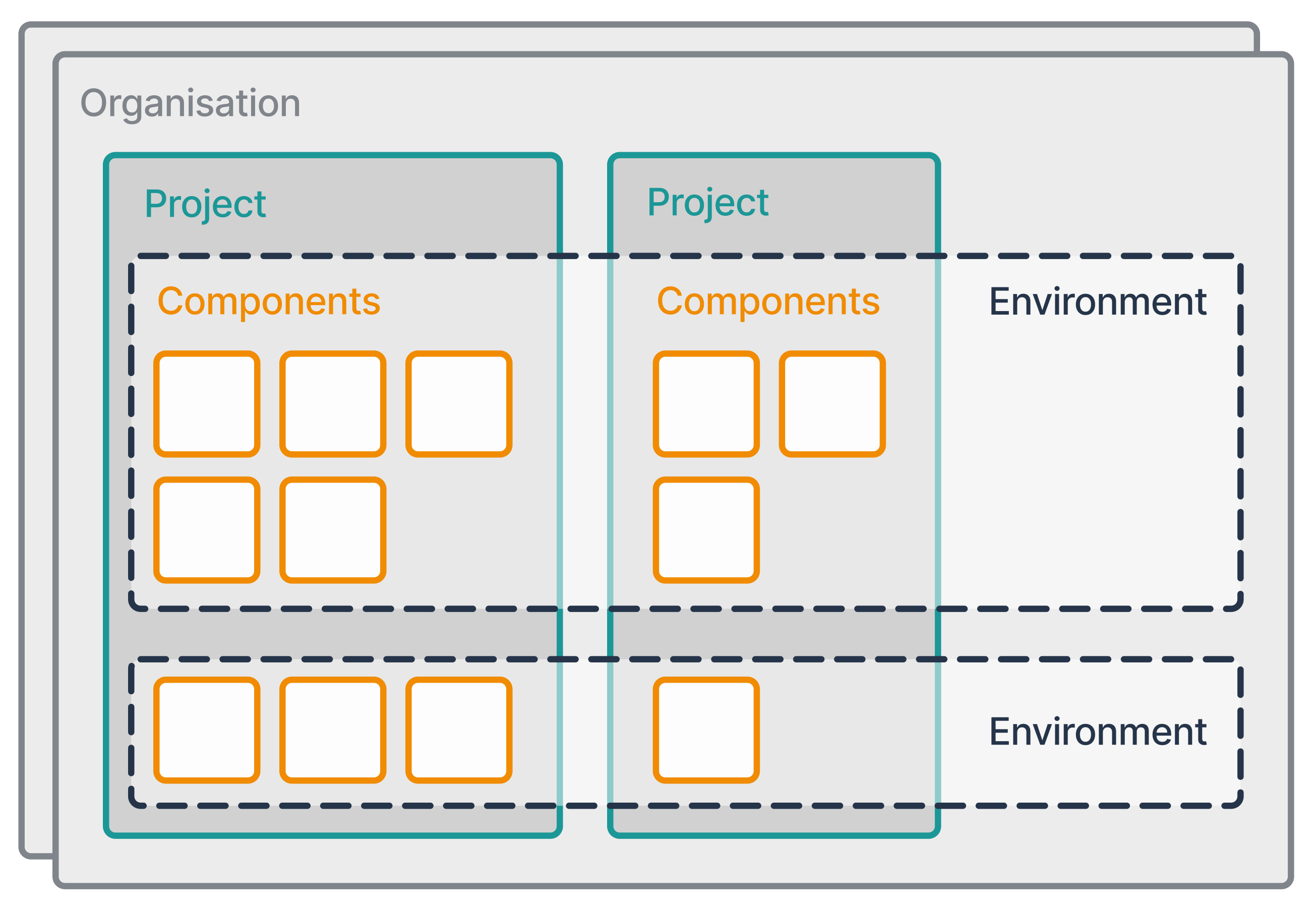
- An Organization is a top-level boundary; multiple organizations can coexist within the same Cycloid instance and can be structured hierarchically using parent and child organizations
- Multiple Projects can coexist within the same organization
- Components belong to projects and define deployable or reusable units
- Environments provide execution context and can span across projects
This separation allows the same component to be reused across multiple environments and the same environment to consume multiple components while enabling reuse, scalability, and governance.
Prerequisites
Cycloid enforces a strict structural hierarchy, but it does not enforce a specific semantic meaning for each layer.
Each layer can represent a team, a service, an application, or any other logical boundary, depending on your needs. The mapping between Cycloid layers and real-world concepts is entirely up to the user.
For example, an Organization may represent a company, a team, or even a large standalone application. Similarly, a Project may represent a product, an internal service, or a functional scope within a larger system. A Component may represent a single resource, a server, a shared infrastructure module, or an entire application, depending on the chosen modeling strategy.